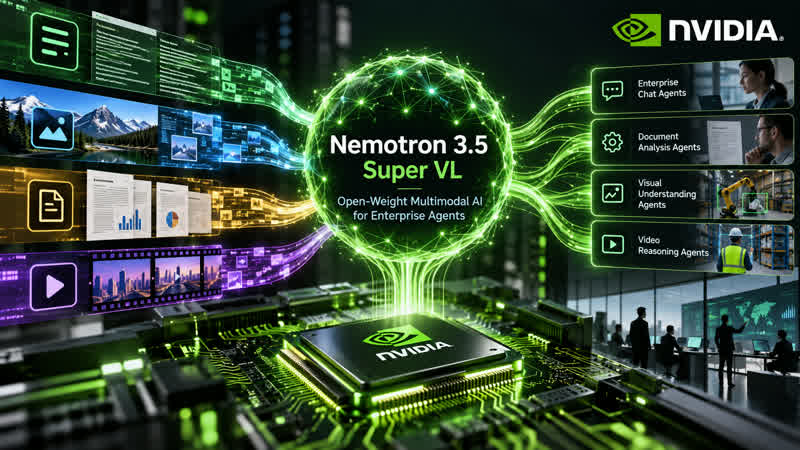
NVIDIA put Nemotron 3.5 Super VL online this Thursday, an open-weight multimodal model with 120 billion total parameters that activates only 12 billion per token, built to run AI agents that stay switched on all day inside companies. The release matters because it shows NVIDIA trying to occupy the space between giant cloud models and small edge models, offering an open middle ground that any development team can download, fine-tune and run on its own infrastructure.
Architecture and what the model reads
Super VL combines a hybrid Mamba-2, attention and mixture-of-experts architecture, MoE for short, with a vision encoder called C-RADIO. In practice that means a single model that understands text, image, document and video in MP4 files up to two minutes long, without bolting on a separate vision model. The context window reaches 1 million tokens, enough to process long contracts, entire codebases or hours of transcription in a single call. NVIDIA says the model was distilled from Nemotron 3 Ultra, the company's heaviest reasoning model, using speculative decoding and NVFP4 quantization-aware training, which delivers accuracy comparable to the large model while using roughly one-fifth of the parameters.
Speed is the sales pitch
NVIDIA claims Super VL delivers up to 5x more throughput than other open models in its class on agentic tasks on a single GPU, and that serving the model through its own Dynamo inference layer cuts latency by 85% while supporting 8x more concurrent users. On two agentic behavior tests the company cites, Hermes Bench and LangChain evaluations, Super VL scored 63.44% and 87.05%, beating Nemotron 3 Ultra's 56.33% and 84.3%. The model also ranks among the top entries on the open OCRBench v2 leaderboard for document reading.
Who is already using it
The day-one adoption is what separates this release from a spec-sheet press release. Scale AI is post-training Super VL for a Skydance vendor-credit agent and for EY's M&A due diligence support; Mercor is using the model in coding agents evaluated on the APEX-SWE benchmark; Ramp is applying the version to financial document reading. Atlassian, CrowdStrike and Dassault Systèmes confirmed integrations underway. The weights are open under the OpenMDW-1.1 license, which permits commercial use, and are already circulating on Hugging Face, OpenRouter, ModelScope and as an NVIDIA NIM container.
The edge side: Bolt for PC and laptop
Alongside Super VL, NVIDIA released Nemotron 3.5 Bolt 74B-A9B, a version with native 2-bit quantization that fits a 74-billion-parameter model into just 24GB of memory, enough to run on RTX cards and the new DGX Spark machines alongside other open programs. The company says it ranks first among open models in its class on PinchBench and second on BrowseComp. An even smaller version, the 4GB Bolt E4B for physical and conversational agents, arrives October 23. The launch coincides with the RTX Spark notebook, announced October 16 and already shipping with Bolt pre-installed in the default app ecosystem.
The limit still worth checking
The performance numbers cited, including the 5x throughput comparison and the Dynamo latency gains, come from NVIDIA's own benchmarks and setup; there is no independent third-party replication published yet. The company also did not detail the real cost of running the full Super VL outside its own optimized Dynamo stack, which leaves a gap between the efficiency promise and what a team without NVIDIA infrastructure will actually be able to reproduce.
The MaxAssistant take
What makes this release different from another parameter-count announcement is the list of real companies already post-training the model on day one, not just the spec sheet. NVIDIA is betting on a specific market slice, the specialized agent that stays locked onto a single task all day, and opening the weights so each company can adapt it to its own data instead of depending on a closed, per-token API. It is worth waiting for independent evaluation before taking the speed numbers at face value, but the immediate availability and the already-declared adoption are facts, not a promise.
Sources
NVIDIA Blog: Open From Data Center to Desktop, NVIDIA Expands Nemotron Family With Super VL and Bolt Models; NVIDIA Technical Blog: Nemotron 3.5 Super VL Powers Specialized Agents With Multimodal Reasoning.